Tag Archives: yoga blog

Stretching my patience: can yoga help my parenting?

I recently had an epiphany in yoga class.

Moving through the different poses, willingly stretching and contorting my body, I tried to let stress and negative thoughts temporarily melt away. When I’m able to focus on proper positioning and breathing, I get the most out of the experience.

I often practice in about 95-degree heat, which loosens my muscles and allows me to go further into poses, testing balance and endurance. Teachers calmly urge us to push through resistance to achieve the best form.

We were doing a posture called pigeon, which requires you to bend one leg in front of you—shin parallel to the mat– and slide the other leg straight behind. If you can manage that, the next step is to reach your torso forward and rest your cheek on the floor. It’s not easy, but if I can get there it’s an incredible hip opener.

While you’d think my inner dialogue during this pretzel would be profanity-laced, I was surprisingly tranquil and in the moment. I tried to fixate on how each part of my body was positioned, and slowly attempted to stretch deeper into the pose.
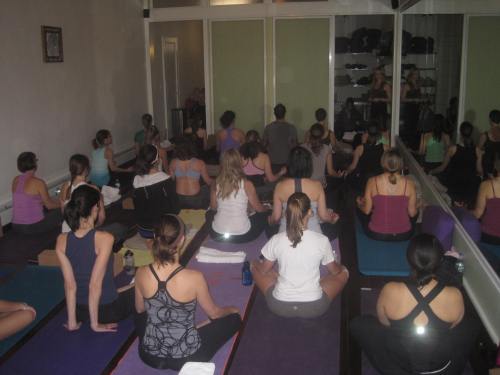
Yoga practice on carpoolcandy.com

As I pushed through discomfort, the teacher encouragingly suggested we let go of any tension. It sounds so simple, but unless you really focus on surrendering the strain, you get caught up in the pain. If you can— even just for a few moments– resist the temptation to squeeze and tense your muscles and just give in, you can actually ease into the pose.

If I can get there mentally, and then physically yield, it’s ephemeral euphoria.

After a few brief but glorious moments, a switch went off in my head and I was aware of the pain and had to readjust.

But as I was trying to override the resistance, I discovered a metaphor for parenting. Often at the end of the day, when I’m tired and my boys (ages 8, 10 and 13) are being sassy and my patience level is low, they start pushing my buttons.

I should be the mature adult who sets a better example of how to act. But when they’re simultaneously barking dinner orders at me; avoiding homework; and tossing a football in the family room, knowing full well that’s against house rules….my composure flies out the window.

If I scold them too harshly, I feel crappy. There’s very little satisfaction in telling off your kids. It’s not like standing up for yourself against a boss or friend who’s done you wrong. You don’t feel empowered, you just feel like a heel.

So while reaching my heels to my mat in down dog, I realized I need to take the Zen attitude I bring to yoga into my parenting.

Easier said than done, I know.

yoga on beach key west on carpoolcandy.com

But if I can trick my mind into believing my limbs are not on fire, I certainly can find a way to abandon my ego and avoid the temptation to snap at my kids when tensions are high.

Breathing helps. Yogis often emphasize the importance of deep steady breaths.  Taking a couple of soothing breaths—and maybe even closing my eyes—when the kids are unruly may ward off a mommy meltdown.

If calm talking and breathing doesn’t work, I can always try standing on my head to get their attention.

What do you do to avoid losing it on your kids? Tell me in the comments.

The moment in yoga class I dread most

I practice yoga two or three times a week but I’ve written very little about it. Many people still hold misconceptions about yoga and dismiss it– either because they think it’s not enough of a workout ( it is!)  or because it’s too touchy feely or cultish (it’s not!)

Fellow yogis get why it’s one of the most powerful things you can do for yourself. It’s exercise, sure, but the work you do in yoga makes your entire body stronger, increases your balance and agility, and teaches you how to breathe more consciously and efficiently. Practicing yoga regularly can also help unclutter your mind, relieve stress, and make you more calm.

It’s that last part that makes some people uncomfortable.  If you’ve never tried yoga or even if you’ve taken only a few classes, it’s difficult to appreciate its positive effects.  I know many people who have come away from initial experiences thinking it’s a bunch of hippies stretching on the floor.

Yoga practice

You have to practice a lot to get familiar with the proper way to do a pose, and then find an ease in holding it. It’s then when you realize how much strength and mental effort it takes to get each pose aligned correctly.

I love the physical challenges of yoga, and the fact that I’m concentrating so hard on perfecting a pose, I can’t think about anything else.  When I leave class, my body feels stretched like I’ve had a massage, and I’m always more placid than when I arrived because –most of the time– I escaped the junk in my mind for an hour.

That’s why I keep returning to my mat.

But I understand why the spiritual aspect of yoga freaks some people out.

I admit then when I first started it intimidated me too. It’s common for teachers to read or tell an enlightening story at the beginning or end of class. Some poses include putting your hands together in prayer. Often teachers ask students to set an intention for their practice, which could be a word (serenity, patience, kindness, etc)  or a dedication to a person who could use positive energy like a loved one who’s sick or going through a hard time.

At first, I thought that part was hokey, but as I got used to it, I came to appreciate the opportunity to think about something outside myself for a moment. Now I look forward to it.

But then there’s the om.

Om is a simple mantra sound– of Hindu or Indian origin–  that’s often chanted three times at the beginning and end of a yoga session.

It’s pronounced: “aaaaaaauuuuuuummmmmmm!”

There are several explanations for why this is done.  Some say it represents the union of mind, body, and spirit at the heart of yoga, coming together in a single sound. Ancient yogis believed that “om” signified the sound of the universe. By chanting it in a class, it brings all the people and energy in the room together as one voice.

It can be a cool experience. But sometimes you just want to stay under the radar and break a sweat.

Om-ing is a routine part of any yoga practice, and although I’ve been taking classes for six years, I’ve never felt completely comfortable in my om skin.

om

Symbol for “om”

Every teacher is different so there’s no universal approach to om-ing. Some start low and get high, others can be monotone. Oms can be sung or chanted, long or short.  You just never know what you’re going to get.

You’re supposed to breathe deeply through the nose to fill up your lungs so you can really belt out your om. But if you don’t get enough air in, you can peter out half-way through and feel lost. Or worse, you can suck in so much air that you’re the last one making noise when the room goes quiet. I hate that.

Some yogis just love being the loudest and/or longest om-er in the room.  Not me. Most of the time, I just want to get it over with and get down dogging.

One of my favorite teachers– who has a hand-pumped harmonium and gorgeous singing voice–plays her instrument at the beginning and end of class and leads her om so beautifully that no matter who’s in the room, it sounds like a chorus at Carnegie Hall. I like those oms. 

It’s true that practicing yoga has the potential to make you uneasy. And I’m not talking about the joys of standing on your head or winding your body into a pretzel. But yoga forces you to connect with the other people in the room in a way other exercise experiences don’t. It encourages you to be in the moment and face how you’re feeling.

There are times when I feel self-conscious and vulnerable.  My reluctance to om is likely part of my initial resistance to those connections. I’ve noticed it’s always easier for me to om at the end of class because I’ve given in to the journey.

Although om is not my favorite part of yoga, I’ve come to appreciate it. It’s another way to push myself through petty insecurities and be more self-aware. I never got that from a treadmill.